
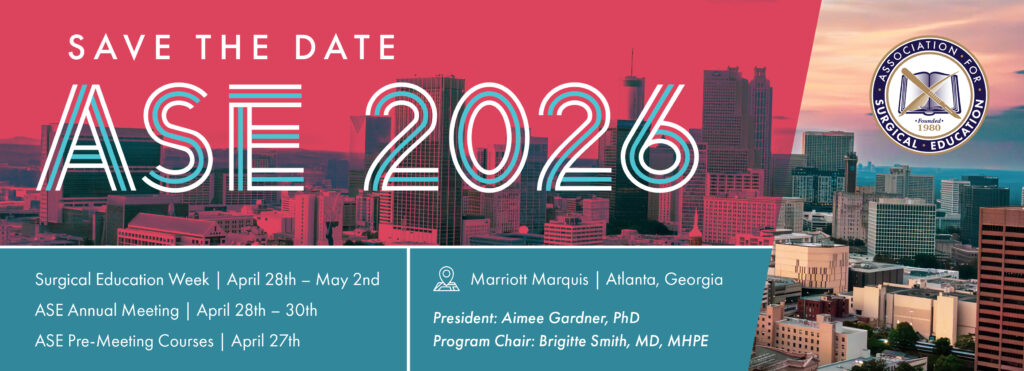
View the 2026 ASE Annual Meeting At-A-Glance Program Below
Subject to change
Activities with a * beside them, denotes a CME session
Monday, April 27, 2026
6:30 AM – 6:30 PM | Atrium Ballroom Pre-Function | Atrium Level
Registration
8:00 AM – 5:00 PM | A704 | Atrium Level
The Surgical Education Research Fellowship program (SERF)
8:00 AM – 4:00 PM | A702 | Atrium Level
The ASE Surgeon Empowerment and Leadership Fellowship (SELF 2.0)
PRE-MEETING COURSES:
Course descriptions and more details can be viewed here
7:00 AM – 4:30 PM | A706 | Atrium Level
Updates on the Surgery Clerkship
8:00 AM – 5:00 PM | A705 | Atrium Level
Shaping and Supporting Surgical Education: Vice Chairs of Education Leadership and Development Course
1:00 PM – 5:00 PM | A703 | Atrium Level
Fundamentals of Communication in Surgery (FCS) Train-the-Trainer
4:30 PM – 6:00 PM | A601 | Atrium Level
ASE Trainee Speed Mentoring Event: Join us for the ASE Trainee Speed Mentoring event, where trainees from all levels can connect with ASE Leaders, including Past-Presidents. Gain valuable mentorship and insights into surgical education and career development in a fast-paced, interactive setting!
6:00 PM – 7:00 PM | Atrium Ballroom Pre-Function | Atrium Level
ASE Welcome Reception: Join us for an evening of collaboration and connection as the Association of Surgical Education hosts their welcome reception. Enjoy refreshments while expanding your professional network and discussing the latest advancements and challenges in the medical field.
Tuesday, April 28, 2026
6:30 AM – 5:30 PM | Atrium Ballroom Pre-Function | Atrium Level
Registration
7:00 AM – 10:00 AM | L504 & L505 | L506 | L507 (Lower Level)
Concurrent Committee Meetings – View the 2026 Committee Meeting Schedule
8:00 AM – 4:30 PM | L508 | Lower Level
Clerkship Coordinator Track Program: Calling all Clerkship Coordinators! We invite you to join us for our own learning experience dedicated to the role the Clerkship Coordinators have in the education of medical students while going through their Surgery Clerkship. Our track will focus on our work and how we can do it better, our specific challenges, and innovative ways we can continue to meet the needs of our changing student populations. This track is great to network with coordinators across the country and share best practices. The group continues to meet on a monthly basis after the annual meeting. Registration for the Coordinator Track Program also includes admission to the Updates in the Surgery Clerkship (formerly Troubleshooting Your Clerkship) Pre-Meeting Course taking place on Monday, April 27th and to the ASE Annual Meeting.
Please note, this course is designed for Clerkship Coordinators. Residency Coordinators / Administrators should contact the ARAS/APDS for residency coordinator programming. See Agenda Here.
8:45 AM – 11:30 AM | A701, A703/A704 & A705 | Atrium Level
The Surgical Education Research Fellowship Program (SERF) *invitation only
8:00 AM – 11:30 AM | A601 | Atrium Level
The ASE Surgeon Empowerment and Leadership Fellowship (SELF 2.0)
10:30 AM – 10:45 AM | Atrium Ballroom BC | Atrium Level
*Welcome Remarks – ASE Annual Meeting begins
10:45 AM -11:45 AM | Atrium Ballroom BC | Atrium Level
*Plenary Session I
11:50 AM – 12:50 PM | *Panel I: When Margin Eclipses the Mission: Balancing Finances, Incentives, and Well-Being in Academic Surgery | Atrium Ballroom BC | Atrium Level
Session Description: Departments of Surgery face unprecedented financial pressure in the current climate while still being asked to deliver excellence in education as well as patient care and research. How do we keep faculty engaged, support surgical training, and protect well-being when “margin is the mission”? This panel will share practical, creative strategies for balancing finances, incentivization, and mission in the current times.
Session Objective 1: Attendees will better understand the financial funds flow and its impact on the missions of an academic surgical department
Session Objective 2: Attendees will be able to envision alternative, non-monetary strategies for incentivizing faculty.
Session Objective 3: Attendees will be able to think creatively about funding sources for surgical education endeavors in their own departments.
Session Objective 4: To allow attendees to cultivate ideas for mitigating burnout and building wellness amidst relentless financial pressure.
12:55 PM – 1:55 PM | Atrium Ballroom BC | Atrium Level
*Plenary Session II
1:00 PM – 5:00 PM | L506/507 | Lobby Level
SCCPDS Workshop: Emerging Fellowship Issues and Innovations in Surgical Education
Description: The educational needs of surgical fellows continue to grow and evolve over time. This session will introduce and discuss some of the current “hot topics” in education. We will discuss onboarding new fellows to maximize their chance of success, novel educational modalities incorporating artificial intelligence and the SCORE curriculum, and evaluation of their progress utilizing entrustable professional activities. The session will conclude with a panel discussion to empower participants to dive deeper into important topics.
1:55 PM – 2:25 PM | Atrium Ballroom Pre-Function | Atrium Level
Break
2:25 PM – 3:25 PM | *Panel II: The Cost of Silence: Mental Health, Suicide, and the Hidden Stories in Surgery | Atrium Ballroom BC | Atrium Level
Session Description: Surgeons and trainees face some of the highest rates of burnout, depression, and suicide across the health professions—yet these struggles often remain unspoken, hidden behind a culture of silence and resilience at all costs. This panel will create a space for open, honest dialogue within the surgical education community by bringing together voices of people in the surgical community with a lived experience with mental health struggles from different perspectives, including personal, peer, leadership, and mental health expert perspectives. Through storytelling, personal reflection, and data-driven insights, the session will illuminate the lived experience of mental health challenges in surgery and the profound consequences of unaddressed distress. By engaging with both the human stories and the structural challenges, this session will empower educators, program leaders, and trainees to return to their institutions prepared to champion a cultural shift—one where mental health is protected with the same urgency as surgical skill and patient outcomes.
Session Objective 1: Develop awareness of the scope and urgency of the mental health crisis in surgery, supported by data and real-world narratives
Session Objective 2: Identify communication strategies to help break the silence, foster psychological safety, and normalize help-seeking behaviors within training programs
Session Objective 3: Apply practical tools for early recognition of warning signs and for initiating supportive, nonjudgmental conversations with colleagues and trainees
Session Objective 4: Formulate institutional approaches to building proactive systems of outreach, peer support, and access to care that reduce barriers and stigma
3:30 PM – 4:30 PM | Atrium Ballroom BC | Atrium Level
*Royce Laycock Guest Lecture
Speaker: Malissa Clark, PhD
Introduction by: Aimee Gardner, PhD
5:00 PM – 6:00 PM | Atrium Ballroom Pre-Function | Atrium Level
Exhibit Hall Open & Quick Shot Reception (Formerly Poster Reception)
5:00 PM – 6:00 PM | Quick Shot Sessions | Atrium Level
Quick Shot Session I – Assessment | A701
Quick Shot Session II – Curriculum | A705
Quick Shot Session III – Simulation / Teaching Methods | A706
Quick Shot Session IV – DEI/GSE/Wellness | A707
Quick Shot Session V – AI/Recruitment | A708
5:00 PM – 5:30 PM | A601 | Atrium Level
SELF Alumni Social
5:30 PM – 7:00 PM | A601 | Atrium Level
SELF Wrap Up Reception and Forum – open to all attendees
6:15 PM – 7:45 PM | A703 & A704 | Atrium Level
Candlelight Session: The Committee on Citizenship and Global Responsibility (CGR) is pleased to host the Candlelight Session. The session gives impetus to ongoing activities pertaining to social issues and invigorates new missions – it seeks to give maximum exposure to ongoing programs across the world. Surgical Educators have traditionally led citizenship and social responsibility activities in medicine and with the changing education landscape, this program promoting innovative education is both relevant and timely.
Wednesday, April 29, 2026
6:30 AM – 6:30 PM | Atrium Ballroom Pre-Function | Atrium Level
Registration
6:30 AM – 7:30 AM | L405 & L406 | L504 | L506 & L507 (Lower Level)
Concurrent Committee Meetings – View the 2026 Committee Meeting Schedule
7:00AM – 7:30AM | Atrium Ballroom Pre-Function | Atrium Level
Morning Refreshments: Open to all SEW & ASE attendees
L508 | Lower Level
Clerkship Coordinator Track Program: see agenda here.
7:30 AM – 7:40 AM | Atrium Ballroom BC | Atrium Level
*Day 2 Welcome Remarks
7:45 AM – 8:45 AM | *Panel III: Failure to Rescue in Surgical Education | Atrium Ballroom BC | Atrium Level
Session Description: Failure to rescue in surgical care is when a complication does not receive timely and appropriate treatment leading to further complications, disability, or even death. FTR often involves the trifecta of delayed recognition, delayed communication and/or delayed action. These clinical enterprise concepts are pertinent in surgical education as well. Unfortunately, trainees and faculty at different stages often struggle in their competencies, as a complication of training. Similar to clinical failure to rescue, delays in recognition, delayed communication and/or delayed action result in significant, negative downstream effects on career and well-being. In this panel, we aim to cover struggling learners spanning UME, GME and faculty.
In this panel, panelists use case scenarios to:
- discuss examples of failure to rescue in surgical education
- enumerate points of rescue
- evaluate strategies to rescue
- draw parallels between clinical enterprise processes and educational failure to rescue.
At the conclusion of the session, attendees will:
-Have tools to address the “failure to rescue” in a more confident and productive manner
-Be able to recognize a struggling learner/faculty member
-Have strategies for early intervention and avoid the “failure to rescue”
8:50 AM – 9:50 AM | Atrium Ballroom BC | Atrium Level
*Presidential Address: ASE President, Aimee Gardner, PhD, delivers this year’s Presidential Address.
9:00 AM – 4:00 PM | Atrium Ballroom Pre-Function | Atrium Level
Exhibit Hall Open
9:50 AM – 10:20 AM | Atrium Ballroom Pre-Function | Atrium Level
Break with Exhibitors
10:20 AM – 11:50 AM | *Podium Sessions
Podium Session I A – AI | A701 | Atrium Level
Podium Session I B – Assessment | A703 | Atrium Level
Podium Session I C – Curriculum Development | A704 | Atrium Level
Podium Session I D – Simulation/Education Tech | A706 | Atrium Level
12:00 PM – 1:00 PM | A601 | Atrium Level
Thinking Out of the Box Session: The Committee on Assessment, Curriculum, and Evaluation (ACE) presents Thinking Out of the Box. Presenters in this session have been tasked with showcasing creative and novel ideas used in their institution that have not yet been subjected to scientific scrutiny. These include but are not limited to, creative teaching methods, new assessment tools, practical faculty development programs, new usage of information technology in the educational enterprise and innovations for interdisciplinary educational courses.
Optional Lunch: All registered attendees of the ASE Annual Meeting or Surgical Education Week are welcome to attend this session. An optional lunch will be available for an additional fee paid with meeting registration. Lunch tickets are $65 and must be purchased in advance.
1:00 PM – 3:30 PM | L401, L402, L403 | Lower Level
*The Surgical Education Research Fellowship program (SERF)
1:00 PM – 2:00 PM | *Podium Sessions
Podium Session II A – Program Evaluation/Wellness/Recruitment | A701 | Atrium Level
Podium Session II B – Faculty Development | A703 | Atrium Level
Podium Session II C – Teaching Methods | A704 | Atrium Level
Podium Session II D – DEI/Wellness | A706 | Atrium Level
2:00 PM – 2:30 PM | Atrium Ballroom Pre-Function | Atrium Level
Break with Exhibitors
2:30 PM – 5:40 PM *Workshops | learn more about the 2026 workshops here
| 2:30 PM – 4 PM (90 Min Workshops) | 4:05 PM – 5:35 PM (90 Min Workshops) | 4:05 PM – 4:50 PM (45 Min Workshops) | 4:55 PM – 5:40 PM (45 Min Workshops) |
| Workshop 1: Building a Family-Friendly Surgical Residency A601 Atrium Level | Workshop 5: EPAs for Educators: A Competency-Based Framework for Intentional Surgical Teaching A601 Atrium Level | Workshop 7: AI-powered Avatars: Making Feedback Delivery Accessible and Individualizable A707 Atrium Level | Workshop 9: The Gift Nobody Wants: Teaching Learners to Get the Most Out of Negative Feedback A707 Atrium Level |
| Workshop 2: Create your own Surgical Education Outreach Program: Keys to success for starting and maintaining a robust outreach effort A705 Atrium Level | Workshop 6: Save the Dolphins (Not Shark) Tank!: An OR Sustainability Pitch A705 Atrium Level | Workshop 8: Start Smarter, Not from Scratch: A Surgical Educator’s Guide to Using National Databases A708 Atrium Level | Workshop 10: The Write Stuff: A Trainee’s Introduction to Impactful Academic Writing A708 Atrium Level |
| Workshop 3: Harnessing Generative AI for Surgical Education A707 Atrium Level | |||
| Workshop 4: Building Better Surgical Teams: Practical Tools for Teaching and Assessing Non-Technical Skills through Simulation A708 Atrium Level |
6:30 PM – 9:00 PM | Atrium Ballroom A | Atrium Level
A night of Art & Accolades: Join us for a special evening of Arts & Accolades, our newly reimagined celebration formerly known as the Awards Banquet. Registration to SEW or ASE includes your ticket to this event.
Thursday, April 30, 2026
6:30 AM – 12:00 PM | Atrium Ballroom Pre-Function | Atrium Level
Registration
6:45 AM – 7:45 AM | A701 | A702 | A705 (Atrium Level)
Concurrent Committee Meetings – View the 2026 Committee Meeting Schedule
7:30 AM – 8:00 AM | Atrium Ballroom Pre-Function | Atrium Level
Morning Refreshments: Open to all SEW & ASE attendees
L508 | Lower Level
Clerkship Coordinator Track Program. See agenda here.
8:00 AM – 9:00 AM | Atrium Ballroom BC | Atrium Level
*J. Roland Folse Guest Lecture
Speaker: Bryce Fuemmeler
Introduction by: Aimee Gardner, PhD
9:30 AM – 12:30 PM | A703 & A704 | Atrium Level
APDS/ASE Finding Aspiring Surgeons for Tomorrow (FAST) Community Outreach Event: Join the ASE and APDS as they host the annual Finding Aspiring Surgeons of Tomorrow (FAST) High School Outreach Event during Surgical Education Week. Students from the local high schools will rotate through different stations encouraging them to consider a career in healthcare.
9:05 AM – 10:05 AM | *Panel IV: Duty-Hour Balance Meets Mastery Learning: The Clock-Smart Approach | Atrium Ballroom BC | Atrium Level
Session Description: The reality of modern surgical training faces the paradox of duty-hour limits, increased patient safety expectations, and rising burnout risk all competing for the same finite resource of time. Simulation-based education has proven to enhance operative performance and improve patient outcomes, yet integrating simulation into residency curricula without exceeding duty hours or compromising wellness remains a major challenge.
This panel, led by simulation directors, program leaders, and education scientists, will explore strategies to align simulation, wellness, and duty-hour compliance within the modern residency framework. We will highlight data showing that proficiency-based progression (PBP) and mastery learning models lead to faster skill acquisition and better performance compared to time-based training. We will also review findings linking structured simulation curricula to improved patient safety outcomes.
Panelists will illustrate real-world scheduling innovations that optimize skill development within duty-hour boundaries. Attendees will participate in an interactive “design sprint” to create a mini-4-week “Clock-Smart” simulation plan tailored to their own institutions.
The discussion will also connect simulation with well-being and ACGME’s updated guidance on fatigue mitigation. By merging data-driven scheduling with evidence-based education, this session models a holistic approach to developing technically competent, psychologically resilient surgeons.
Attendees will leave with:
• Practical templates for time-efficient simulation integration
• Benchmarked metrics for skill acquisition, wellness tracking, and compliance
• A structured planning tool for implementing a “Clock-Smart” curriculum at their home program.
This panel embodies ASE’s mission to advance surgical education through innovation, collaboration, and actionable takeaways. Participants will engage directly through live polling, design exercises, and facilitated reflection to ensure an interactive session that moves beyond lecture to collective problem solving.
10:30 AM – 11:30 AM | *Panel V: Decoding the Impact of Preference Signals: Exploring General Surgery Program Director, Applicant, and Medical Student Advisor Perspectives| Atrium Ballroom BC | Atrium Level
Session Description: Preference signaling was first implemented in the resident recruitment process in the 2021-2022 match as an attempt to provide an objective metric for program directors (PDs) to identify applicants highly interested in their program while decreasing interview hoarding, which had been highly prevalent since the transition to virtual interviews in 2020. In 2024, the Association for Program Directors in Surgery (APDS) increased the number of signals per applicant from 5 to 15. In an attempt to study the impact of this change, the Surgical Education Research Committee (SERC), Graduate Surgical Education Committee (GSEC), and the Collaboration of Surgical Education Fellows (CoSEF) undertook several research projects this past year, funded by the ASE, to investigate PD, medical student advisor, and applicant experiences with and attitudes toward the current preference signaling system. These mixed methods studies involved semi-structured interviews with the aforementioned stakeholder groups, qualitative thematic analysis, followed by a survey of general surgery PDs and applicants based on the themes identified.
While many commonalities between groups were noted, such as a common understanding of the purpose of preference signaling and a need for greater transparency regarding how programs are using signals, stakeholder opinions diverged in key areas, such as how applicants should be allocating their signals and attitudes toward home or visiting sub-interns signaling their home institution. These results highlight a need for discourse between stakeholder groups with respect to the future of preference signaling. Therefore, we propose a preference signaling panel at ASE this year. Panelists will include program directors, medical school advisors, and general surgery residents from both community and academic programs, as well as a representative from the APDS signaling task force. This panel will start with a summary of the APDS signaling task force and SERC/GSE/CoSEF signaling working group findings, followed by a panel discussion of these results. The panel discussion will be structured around common themes identified in previous preference signaling work, aiming to provide pragmatic guidance on: how general surgery residency applicants should determine their competitiveness and allocate their signals, how general surgery program directors can approach interpreting signals to improve efficiency in application review, how many signals per applicant is the ideal number, how much transparency general surgery programs should provide to applicants regarding how they use signals, whether home and visiting sub-interns should signal their home or visiting institutions, and how the approach to signaling may vary for applicants who are international medical graduates, DO students, couples matching, or dual applying. The discussion will highlight where stakeholder perspectives align or diverge.
This signaling panel represents a unique integration of three major stakeholder vantage points (PDs, applicants, and medical student advisors) and will provide a holistic understanding of preference signaling. Such cross-stakeholder discourse is critical to shaping an inclusive, transparent, and evidence-driven future for surgical recruitment.
10:05 AM – 10:30 AM | Atrium Ballroom Pre-Function | Atrium Level
Break
11:30 AM – 11:45 AM | Atrium Ballroom BC | Atrium Level
Closing Remarks & Award Announcements